The Futures Summit: A New Era of Development Cooperation
April 10, 2026 • 8:30 am – 4:30 pm EDT
Hosted by Global Development

Photo: CN-STR / AFP via Getty Images
Over the past few years, China’s solar industry has entered a period of intense upheaval. Price wars and margin compression have forced industry leaders—including Jinko Solar, Trina Solar, and JA Solar—to report significant losses. These firms, along with LONGi Green Energy and Tongwei—the industry’s top five—slashed their workforce by over 30 percent in 2024. The market is facing industry consolidation and exits not seen in over a decade, as over 40 smaller firms have filed for bankruptcy, been acquired, or exited the market. Chinese regulators are accelerating this process, which will have ripple effects across global solar markets.
Several critical questions arise: Does this phase erode China’s leadership in solar, or entrench it further? Is it a window for others to close the gap, or a prelude to deeper market displacement? And when the current wave of capacity consolidation settles, what will the next global competitive order look like? The answer is already emerging. Rather than opening space for rivals to catch up, the current shocks are forging a more resilient Chinese solar core. By embedding deeper into global value chains and securing a technological lead, China is effectively reshaping the industry’s future trajectory to its own long-term advantage.
China’s first major solar shakeout began in 2012. During the 2009–2010 frenzy, Chinese solar majors expanded rapidly, leveraged by debt, to meet European and U.S. demand, exporting 90 percent of their output. When the 2011 Eurozone crisis hit, solar subsidies were gutted, sharply curbing demand. The sector hit its “darkest hour” in 2012 when U.S. anti-dumping duties and EU trade probes shuttered overseas markets, forcing hundreds of China’s solar firms to cease operations. The crisis peaked in 2013 with the landmark collapse of two solar giants, Suntech and LDK, prompting Beijing to salvage the industry through aggressive domestic installation targets and “Price Commitment” deals with the European Union. The crisis ultimately transformed China’s solar sector from a fragmented landscape into a more consolidated, globally competitive powerhouse.
Today, China is the undisputed global leader in the solar industry. It dominates the solar supply chain—by an extraordinary margin. In 2024, China produced 93.2 percent of the world’s polysilicon, 96.6 percent of wafers, 92.3 percent of photovoltaic (PV) cells, and 86.4 percent of PV modules, as China Photovoltaic Industry Association (CPIA) data show. However, a new wave of crises has once again swept through China’s solar industry, manifesting in a phenomenon the Chinese government has termed “involution” (internal fierce competition) to avoid the more politically charged concept of overcapacity. This occurs alongside growing resistance to Chinese firms “going global” (overseas expansion), as tightening U.S. supply chain tariffs and EU diversified-origin rules increasingly squeeze access to high-value markets.
China’s solar sector has been pushed into a fierce price war as manufacturing capacity far outstrips global demand. In 2024, the world had enough PV manufacturing capacity to produce more than twice the modules actually installed, according to the International Energy Agency. Much of this overshoot stems from China’s 2020 dual-carbon pledge, which spurred local governments to shower the solar industry with land, tax, and financing incentives—drawing in massive capital and triggering repetitive, low-quality investment. Since 2023, prices across the solar value chain have collapsed: Module prices dropped by half in 2023 and a further 25 percent in 2024, while polysilicon prices plunged from RMB 230,000/ton to RMB 65,000/ton in 2023—over a 70 percent decline—followed by another 40 percent drop in 2024, according to data from CPIA annual reports. In 2025, PV product prices fluctuated significantly, with wafers, cells, and modules remaining at depressed levels. Despite CPIA’s efforts to promote industry self-discipline and coordinate production to curb disorderly competition, price pressures have persisted.
The European Union is weaving a complex web of institutional hurdles focused on supply chain resilience and carbon transparency. The Foreign Subsidies Regulation already acts as a selective filter, triggering Chinese withdrawals from some major tenders, while the Net-Zero Industry Act mandates domestic manufacturing targets and caps single-source procurement at 50 percent—though member states retain leeway to bypass these rules for cost reasons. Furthermore, the proposed Industrial Accelerator Act seeks to cement these targets by streamlining permitting and creating “Industrial Acceleration Zones” to fast-track domestic clean-tech production. Additionally, while the Carbon Border Adjustment Mechanism does not directly tax PV modules, it imposes administrative burdens and indirect costs via carbon reporting for aluminum and steel components, gradually eroding Chinese exporters’ price advantage.
Unlike Europe’s attempt to balance trade with domestic growth, the United States has moved toward a more restrictive environment for Chinese solar products. While Section 301 imposes 50 percent tariffs, the actual exclusion is driven by anti-circumvention rulings that target Chinese-affiliated production in Southeast Asia and the Uyghur Forced Labor Prevention Act, which detains shipments at the border over supply chain compliance. These combined measures have effectively decoupled the U.S. market from the Chinese supply chain.
Facing a new downturn, China’s solar industry is reshaping its export strategy. Chinese exports have faced a rising wave of tariffs and other nontariff barriers due to concerns over dumping and unfair competition in multiple regions that are trying to develop their own industries. Total export value fell noticeably, yet monthly shipments remain sizable at the billion-dollar level. Even as trade barriers rise, export capacity keeps expanding, with firms diversifying into new markets to navigate the shifting global landscape. Initially driven by U.S. tariffs, the shift toward exporting intermediate products like wafers and cells—rather than targeted modules—may now help Chinese firms meet the European Union’s diversification requirements as U.S. restrictions on Southeast Asia intensify. At the same time, export destinations are diversifying: For PV cells, the Asia-Pacific region has become the main export market; for PV modules, the European Union remains the largest market by value, though its share is declining, while Asia-Pacific and Middle Eastern countries are rapidly absorbing a growing portion of demand.
Beyond trade, China has been extending its global value chain through overseas investment and manufacturing—potentially helping firms meet the European Union’s diversified origin requirements. Facilities in Indonesia, Vietnam, Malaysia, Saudi Arabia, and beyond help reposition in changing tariff environments, foster local employment, and position Chinese firms not merely as suppliers, but as builders and operators of complete solar ecosystems, embedding themselves deeper into regional markets.
In 2004, the global solar patent filing landscape was led by Japan (43.0 percent), with China holding only a minor 13.0 percent share. Just two decades later, the picture looks markedly different: China’s share of global patent applications has surged, reaching around 65.0 percent by 2024, according to CPIA’s 2024-2025 China PV Industry Annual Report. This dramatic transformation underscores how the transfer of the global PV manufacturing hub successfully propelled China into its role as the primary engine for technological advancement in the global solar industry.
China was initially a follower when first-generation solar technologies emerged. By leveraging innovations in manufacturing processes, it steadily boosted conversion efficiency while sharply cutting costs. China’s innovation cycles far outpace the rest of the global solar sector, rapidly advancing across first-generation sub-technologies—and the pace of turnover continues to accelerate. Within less than a decade, China progressed from relying on traditional c‑Si (BSF) cells to deploying large-scale improved c‑Si (PERC) cells, and more recently has been moving toward the widespread adoption of advanced c‑Si (TOPCon) technologies, which grew from 8 percent to 70 percent of the market in just three years.
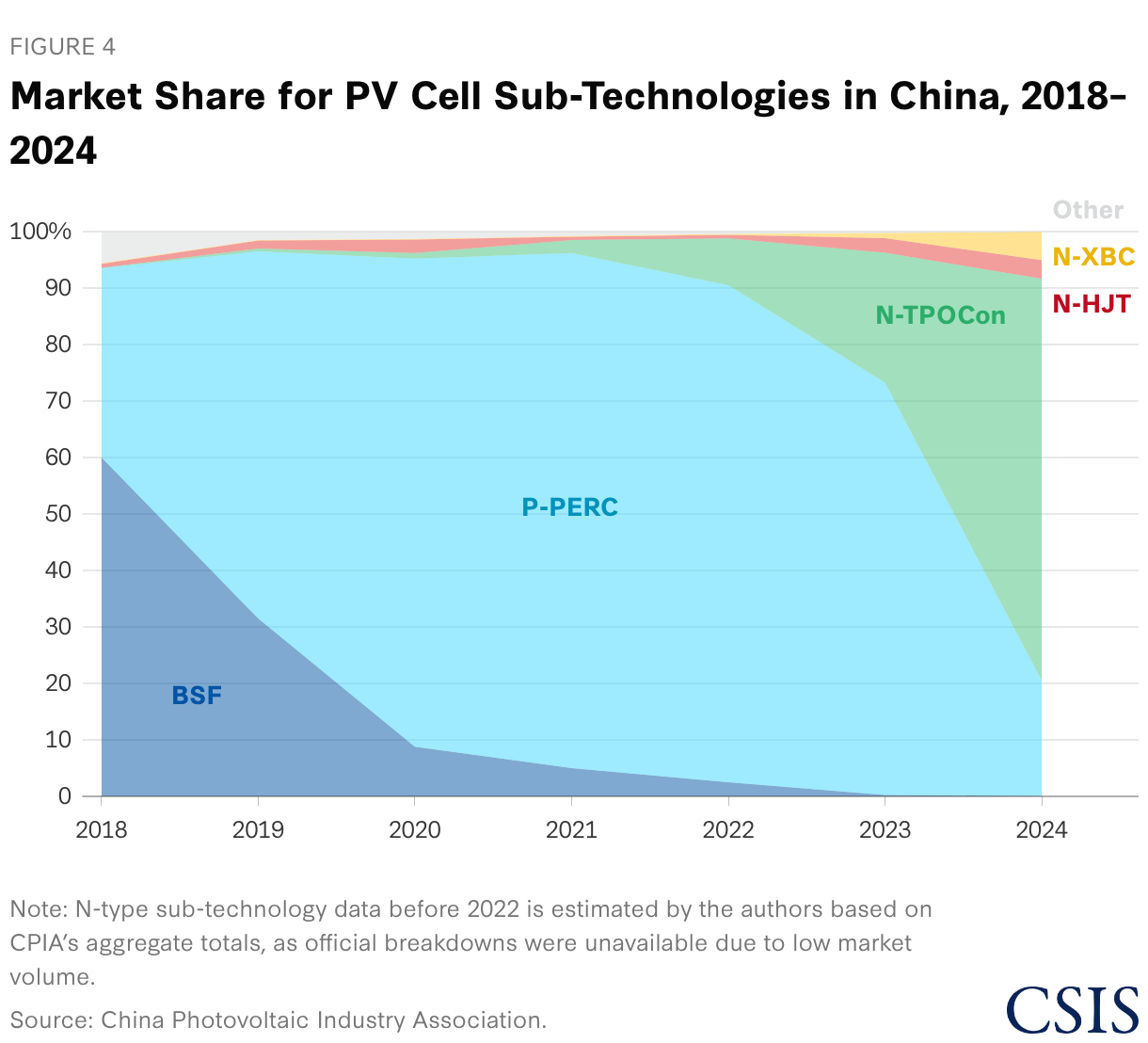
Chinese solar firms have reached an average conversion efficiency (the proportion of sunlight converted into electricity) of mass‑produced n‑type TOPCon cells of 25.4 percent by 2024, up from 21.8 percent for PERC cells in 2018, as CPIA data show. Over the same period, U.S. First Solar concentrated on thin‑film CdTe technology, upgrading from Series 6 to Series 7 modules, with conversion efficiency rising from roughly 18 percent to 20 percent.
China strategically chose to forgo large-scale development of second-generation thin-film solar technologies. Thin-film cells, such as CdTe and CIGS, suffer from lower efficiency and higher production costs compared with crystalline silicon, making them less competitive in the mass market. By contrast, China’s focus on c‑Si technologies, especially as silicon prices have remained low, has allowed rapid scale-up and global market dominance.
Today, China is leading in third-generation solar technologies, particularly perovskite and tandem cells, positioning itself at the forefront of next-generation photovoltaics. According to the National Renewable Energy Laboratory’s January 2026 PV Best Research‑Cell Efficiency Chart, LONGi Green Energy holds the world record for the highest conversion efficiency in perovskite/silicon tandem technology, achieving 34.85 percent. Meanwhile, the Nanjing University/Renshine collaboration holds the world record for the highest conversion efficiency in perovskite tandem technology, achieving 30.1 percent. Hybrid designs integrating perovskite with silicon systems point to a clear path for next-generation, high-efficiency solar deployment.
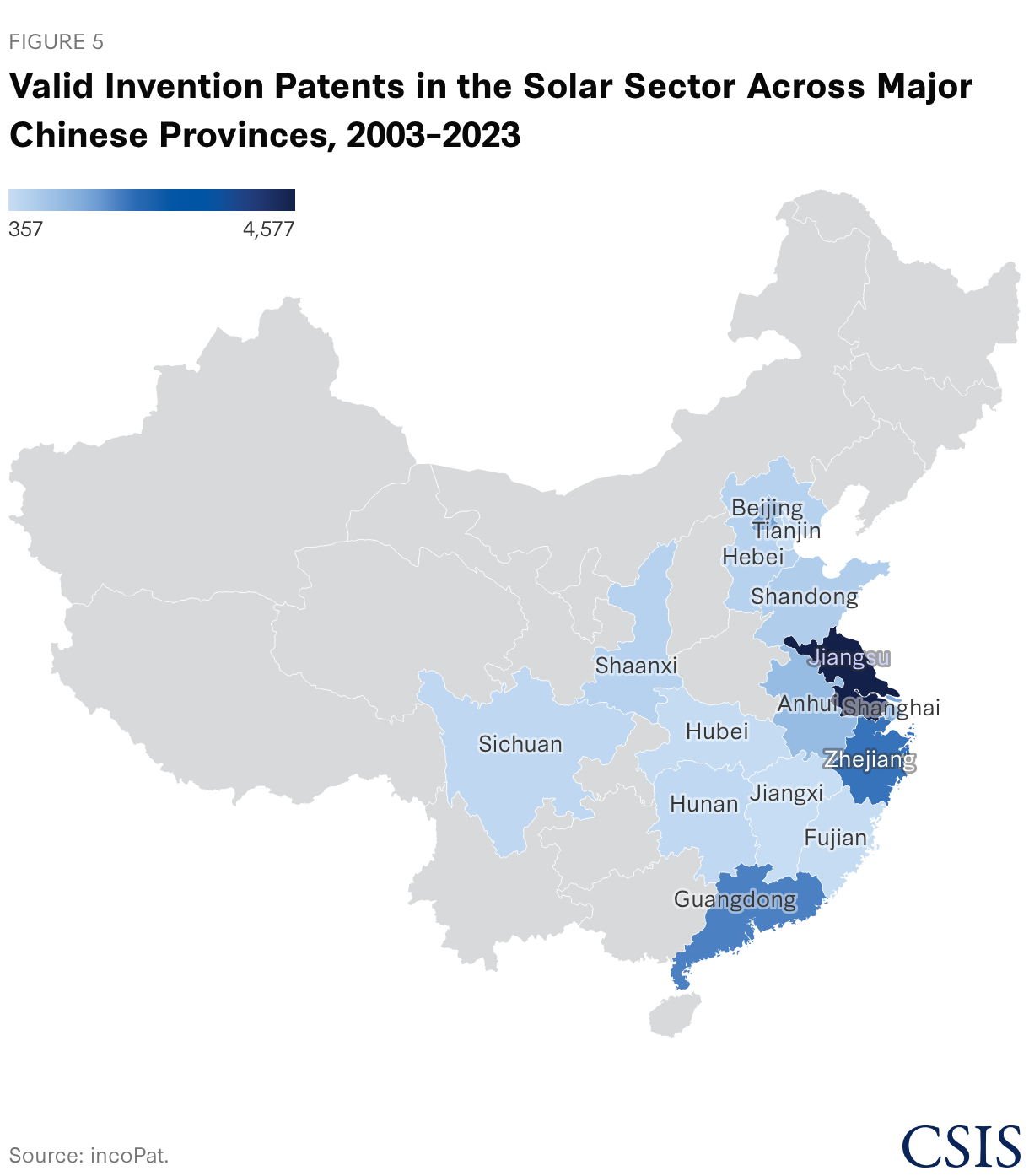
China’s solar innovation operates on three intertwined layers. The central government sets strategy, funds R&D, and provides tax and subsidy incentives. Provincial authorities reinforce this with local development plans, land and tax perks, and targeted innovation funds. Guangdong backs perovskite and tandem cells, Zhejiang pushes higher module efficiency, Jiangsu and Anhui offer high-tech manufacturing subsidies, and Shanghai and Beijing support research-intensive pilot projects. Market actors—policy banks, industrial funds, and leading firms—inject capital, drive technology, and collaborate with research institutes, creating a self-reinforcing system that keeps China at the forefront of solar technology.
Provinces with robust industrial infrastructure and deep talent pools have emerged as focal points of technological leadership. Over the past two decades, the majority of valid invention patents (active patents protecting novel technical inventions) in China’s solar industry has been clustered in manufacturing centers such as Jiangsu, Zhejiang, and Anhui, as well as in talent-rich and research-intensive major hubs like Guangdong, Beijing, and Shanghai. These manufacturing centers are not only high-capacity production sites but also innovation engines, generating local ecosystems that complement the breakthroughs coming from major city research labs.
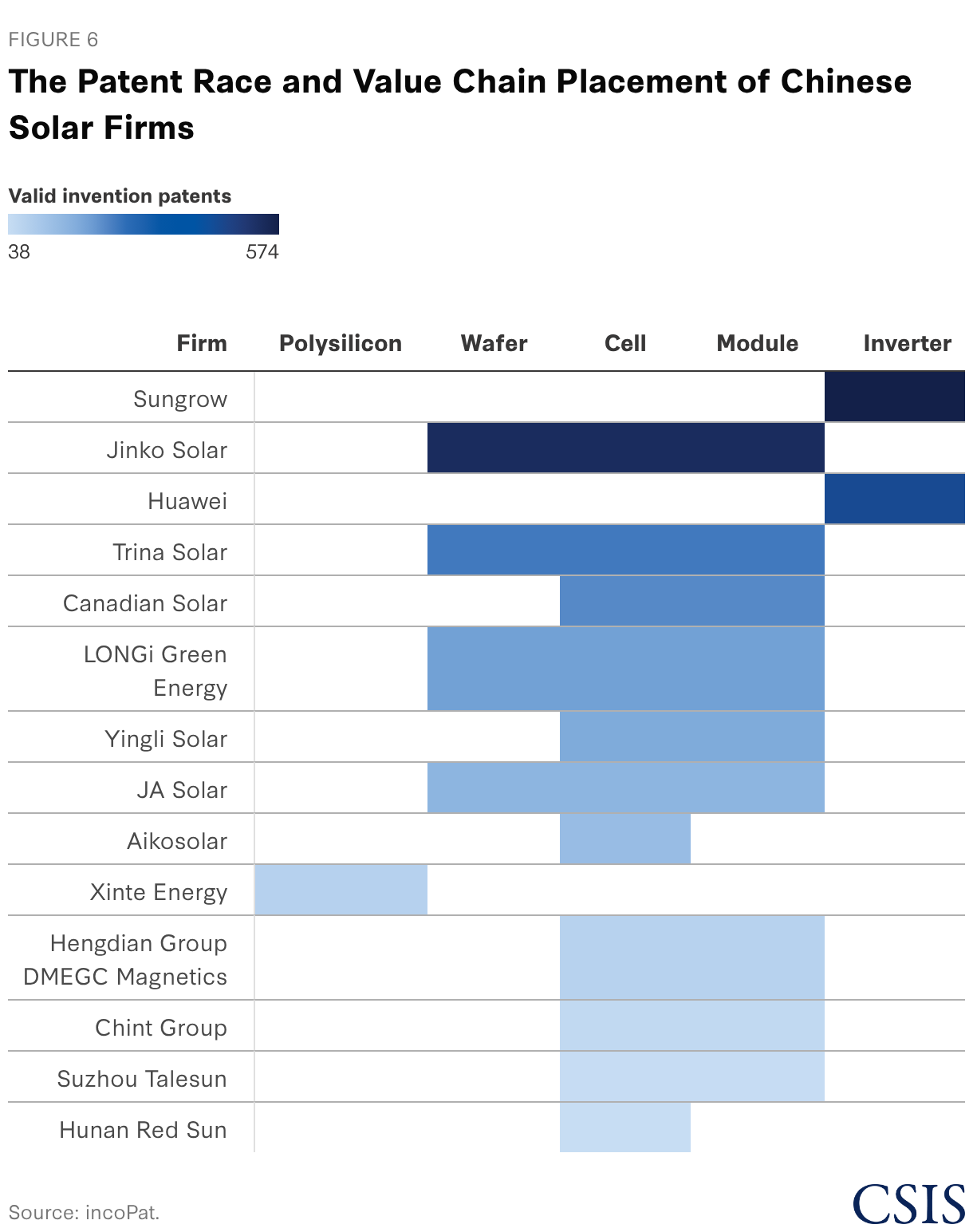
Chinese firms, most of them private, are the core driving force of PV innovation, accounting for over 75 percent of China’s total patent applications in the solar sector. The intense market volatility has exacerbated the technological arms race among solar firms, consequently reshaping the competitive landscape of the solar market. Leading Chinese solar firms are pursuing vertical integration, extending technological advantages and patent coverage across the industry’s core segments—including wafers, cells, and modules—as exemplified by JinkoSolar, Trina Solar, LONGi Green Energy, and JA Solar. Mid-tier players are also growing in size and importance, concentrating their resources on innovation within a single link of the value chain; for instance, Sungrow focuses exclusively on inverters, while Xinte Energy specializes solely in polysilicon.
Despite mounting pressures—from tightening domestic margins to rising trade barriers abroad—China’s position at the center of the global solar ecosystem remains largely intact. To navigate these shocks, Chinese firms have not only shifted export strategies and expanded into emerging markets, but have also embedded themselves deeper in global value chains, and secured an innovation edge that is reshaping the industry’s future trajectory.
Chinese regulators have taken a series of forceful measures to accelerate this process by driving market consolidation, tightening industry oversight, and strengthening enforcement against intellectual property (IP) infringement. In mid‑2025, a strategic acquisition fund was planned to acquire and retire roughly one‑third of the industry’s low‑efficiency polysilicon capacity. By December 2025, the platform was formally established with an RMB 3 billion capital base, backed by major upstream solar producers and the industry association. Concurrently, the Ministry of Industry and Information Technology (MIIT) intensified efforts by issuing the 2025 Annual Polysilicon Industry Special Energy Saving Supervision Task List in August 2025, targeting 41 companies for strict energy efficiency inspections. This was followed in late 2025 by a joint initiative from the National Intellectual Property Administration and MIIT to crack down on IP infringement through export bans and exclusion from state-owned utility procurement, shifting competition toward technological innovation.
The heightened price pressure has pushed global PV module prices to historic lows—often dipping below the 1 RMB/watt mark—making it economically difficult for non-Chinese manufacturers to compete on cost. Consequently, local solar manufacturers across Europe, India, and the United States, whose products are often 50 percent to 100 percent more expensive than imports, are grappling with severe financial losses and bankruptcy risk despite receiving government subsidies. Norwegian Crystals, a crucial silicon ingot supplier, officially declared bankruptcy in late 2023 due to unsustainable price pressure. Following this, Swiss-based solar firm Meyer Burger closed its main German factory in 2024, and despite its strategic shift to the U.S. market, it ultimately closed its U.S. plant and filed for bankruptcy in 2025.
The intense “involution” within China’s solar sector has simultaneously amplified global supply chain risk by cementing its near-absolute monopoly in the upstream segments—polysilicon, wafers, and cells. As a result, non-Chinese manufacturers globally remain heavily reliant on China for cost-competitive upstream materials, hindering their efforts to build localized supply chains. The U.S. domestic module manufacturing capacity grew from 14.5 gigawatts in 2023 to surpass 50 gigawatts in early 2025, yet wafers and cells still rely mostly on imports. This reliance exposes international developers to significant policy uncertainty and escalating compliance costs. In Europe, this manifests as intensified regulatory pressure for supply chain localization, alongside a slowdown in deployment as domestic constraints and cooling demand begin to outpace the influx of Chinese exports. In the United States, the challenge is compounded by a projected fall in demand due to the repeal of the Inflation Reduction Act and a generally anti-renewable federal stance.
This dynamic creates a significant technology gap challenge: Chinese firms are rapidly accelerating their transition to advanced N-type (such as TOPCon, HJT, and BC) and next-generation technologies at a scale and speed unmatched by international competitors. Consequently, global counterparts find that even when their products meet local manufacturing standards, their component efficiency and performance often lag behind China’s latest-generation offerings, leaving them vulnerable to technological obsolescence and market marginalization.
For global solar competitors, the key to success lies not in engaging in a price war, but rather in establishing unique competitive advantages through localization, technological differentiation, supply chain resilience, and the effective utilization of policy incentives. In certain contexts, global suppliers may find that collaboration with Chinese partners—rather than direct competition—helps local firms accelerate to the competitive frontier, with spillover benefits for emerging technology pathways. Competing head-to-head with Chinese suppliers through industry supports and high trade barriers can lead to a protected yet globally uncompetitive industry.
Michael Davidson is a senior associate (non-resident) with the Trustee Chair in Chinese Business and Economics at the Center for Strategic and International Studies and an associate professor at the School of Global Policy and Strategy and the Mechanical and Aerospace Engineering Department at the University of California San Diego. Sandy Qian is a research associate in the School of Global Policy and Strategy at the University of California San Diego.
This report is made possible by general support to CSIS. No direct sponsorship contributed to this report.


Report by Ilaria Mazzocco and Ryan Featherston — October 22, 2025

Report by Scott Kennedy — March 2, 2026

Commentary by Ilaria Mazzocco — January 22, 2026