The Futures Summit: A New Era of Development Cooperation
April 10, 2026 • 8:30 am – 4:30 pm EDT
Hosted by Global Development

Photo: Kevin Sutherland/Bloomberg via Getty Images
This analysis is a component of Part II of a three-part series, A New Landscape for Development, that examines the context, current state, and early impacts of the dramatic changes to U.S. foreign assistance in 2025.
Over the past 80 years, the United States has used foreign assistance as an important instrument to advance national security interests, promote commercial ties with countries, and alleviate humanitarian and health crises around the world. From rebuilding Europe after World War II and combatting communism to leading the global war on terror, foreign assistance has been vital in safeguarding U.S. interests at home while promoting peace and prosperity abroad.
However, the landscape of foreign assistance in the United States and in other donor countries is shifting. Competing domestic priorities, budgetary constraints, and evolving geopolitical dynamics are redefining how the United States engages with the world. The Trump administration is reshaping its foreign assistance strategy arounds the goal of “making America safer, stronger, and more prosperous.” Meanwhile, partner countries increasingly demand to be treated as equals rather than charity cases, instead seeking trade, investment, and technology partnerships with the United States.
The United States provides foreign assistance to sectors and causes including responding to humanitarian crises, combating health pandemics, supporting economic growth efforts, and promoting human rights, democracy, and good governance. Building on past CSIS work and existing literature, this white paper covers key questions related to the future of U.S. support for economic growth globally.1 Because the largest share of U.S. foreign assistance is bilateral (i.e., directed from U.S. government agencies to specific countries) our analysis focuses on this dimension.
As the world faces profound changes, including demographic transitions, geopolitical tensions, and technological disruptions, U.S. foreign assistance must evolve and undergo a dramatic transformation. In this new era, there is a timely opportunity to elevate efforts that drive economic growth abroad. It is a function long overdue to take center stage.
Before January 2025, U.S. foreign assistance was structured into five key sectors, including: (1) peace and security, (2) promoting economic growth, (3) investing in people, (4) governing justly and democratically, and (5) humanitarian assistance. Historically, each of these categories has been funded by different budgetary accounts with no specific line items for any of the five categories.
Within this framework, the United States has engaged in economic growth programs abroad to strengthen the foundation of a country’s market economy. The activities included expanding access to energy and infrastructure, building a skilled workforce, improving the productivity of agriculture and industry, and supporting legal and regulatory reforms that make it easier to do business and encourage foreign direct investment (FDI). The goal of these activities was to promote economic stability abroad and increase income levels in partner countries, while protecting U.S. national security interests and promoting commercial opportunities for U.S. firms.
These programs and activities were spread out throughout U.S. government agencies as well as multilateral organizations that the United States founded and funds (e.g., the United Nations, World Bank Group, and IMF, as well as regional development banks). The main U.S. bilateral agencies that carry out economic growth activities overseas include the State Department, which merged with the U.S. Agency for International Development (USAID) in July 2025; the U.S. International Development Finance Corporation (DFC); the Millennium Challenge Corporation (MCC); the U.S. Trade and Development Agency (USTDA); and the U.S. Export-Import Bank (EXIM), using a mix of financing instruments (see Table 1).
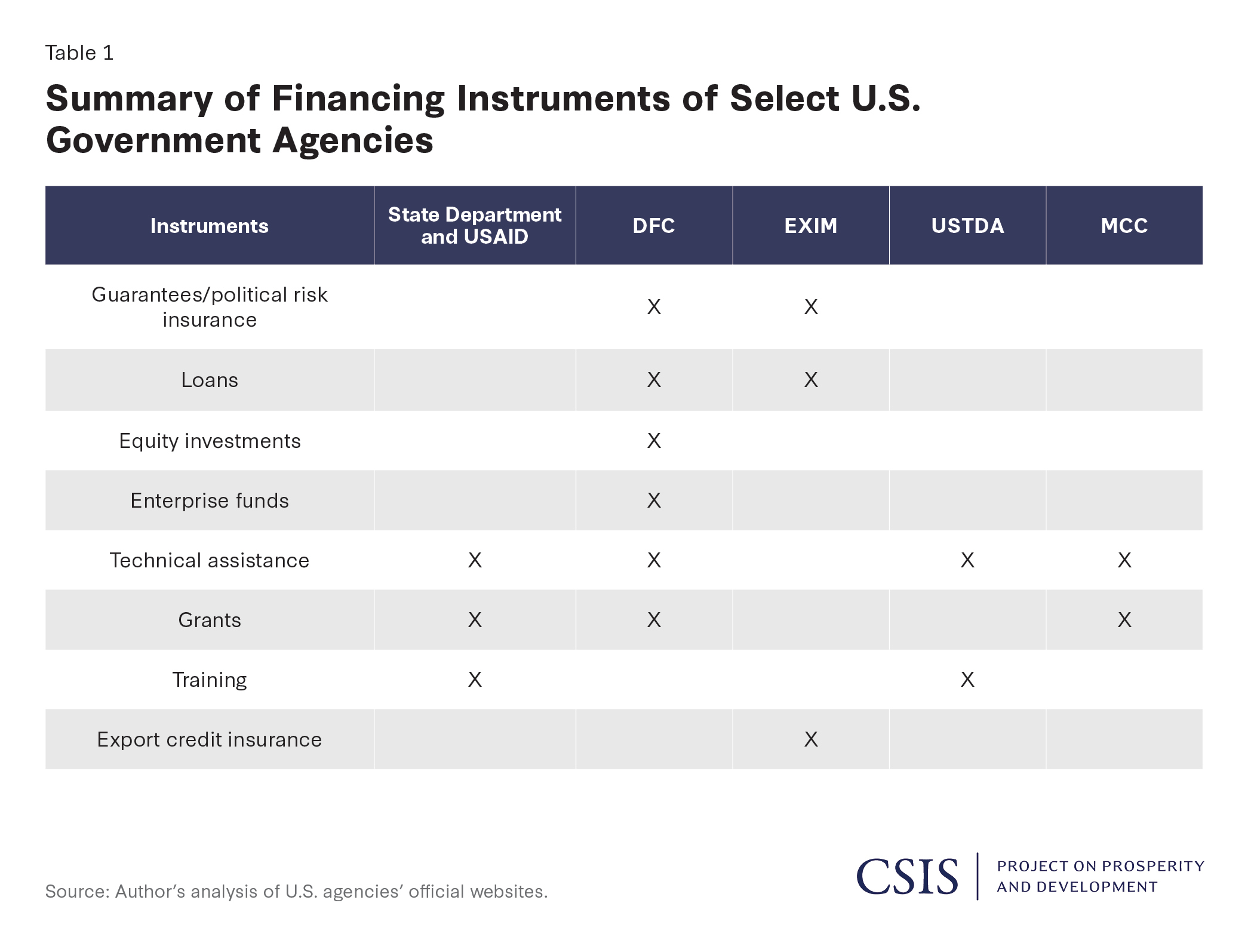
In 2024, the United States obligated close to $11 billion, or 13 percent of total foreign assistance, to economic development activities. Data for 2025 is still being compiled, but in light of sweeping budgetary cuts and recissions (i.e., cancellation of previously approved budgets) this amount will likely be approximately 30–40 percent lower than in 2024. It is important to note that the available data only captures the money that is appropriated to foreign assistance; resources mobilized through agencies such as DFC and EXIM are not accounted for in this resource envelope.
For the fiscal year 2025 budget cycle, approximately $8.3 billion was appropriated toward economic assistance (including Development Assistance; Economic Support Fund, Assistance to Europe, Eurasia, and Central Asia, and Democracy Fund). However, though a recission process, the president proposed lowering this amount to $ 3.6 billion for FY 2025.
For the FY 2026 budget cycle, final figures are still being determined:
The Trump administration is aligning foreign policy more closely with U.S. national security and commercial interests, guided by its commitment to “making America safer, stronger, and more prosperous.” Both the president’s FY 2026 budget request and the House’s bill aim to utilize foreign assistance to support U.S. interests and counter Chinese influence, rather than funding traditional broad, long-term development projects. Consistent with this strategic shift, there are significant cuts to programs that are viewed as peripheral to U.S. security interests (such as multilateral climate funds), while bolstering programs that produce direct economic and security returns.
Both the president’s FY 2026 budget request and the House’s bill aim to utilize foreign assistance to support U.S. interests and counter Chinese influence, rather than funding traditional broad, long-term development projects.
Within this landscape, U.S. capabilities on economic growth are evolving and there remains a high degree of uncertainty about which agencies will endure and take the lead. USAID, which provided significant technical assistance in this space, has been minimized and merged with the State Department. Through an executive order, President Trump also eliminated funding for several smaller U.S. government organizations involved in international economic growth work, including the Inter-American Foundation and the U.S. African Development Foundation. The administration’s stated approach is to streamline development efforts and save the government money.
As mentioned above, the administration has also proposed the A1OF, a pool of $2.9 billion that would be managed as a flexible fund by the State Department to “provide targeted support for enduring and emerging priorities” that advance U.S. national interests. Notably, this flexible language gives the State Department more discretion on how to allocate funds in alignment with U.S. economic and geopolitical interests.
In addition, various U.S. government agencies that promote economic development overseas remain active and could be leveraged in this new era of foreign assistance, including the DFC, USTDA, MCC and Exim:
These trends seem to signal that agencies generating returns to U.S. taxpayers and supporting U.S. jobs are more likely to be spared by cuts, in contrast to those agencies deploying solely grant-based tools.
Western donors are undergoing similar realignments, underscoring broader global trends in foreign assistance. Globally, aid is being framed more explicitly as a tool for national interest rather than charity, with countries increasing spending to support their own defense, security, and economic wellbeing.
Across Europe, traditional donors are trimming aid commitments simultaneously for the first time in decades. The United Kingdom, for example, plans to cut its foreign to 0.3 percent of national income by 2027 from 0.7 percent in 2021, to free up funds for defense and security interests. France has slashed its development budget by 35 percent for 2025 while Germany has reduced foreign aid by $1 billion in favor of increasing its defense budget.
This realignment presents an opportunity for development finance institutions to provide more funding for private sector activities and catalyze additional capital, bolster countries’ capacity to improve domestic resource mobilization, and implement innovative financing tools to stretch limited funds—a shift highlighted at the July 2025 Financing for Development summit in Seville.
At the same time, the reduction of aid commitments from the United States and Europe has opened the door for other donors, such as China, the Gulf Cooperation Council countries (e.g., Qatar, Saudi Arabia, and the United Arab Emirates), diaspora funds, and philanthropic organization to step in, although at lower volumes.
U.S. economic growth efforts abroad should focus on three broad goals: (1) promote prosperity and economic self-reliance in developing countries, (2) create commercial opportunities for U.S. companies, and (3) protect U.S. national security interests. In this regard, instead of following the traditional grant-based model, U.S. foreign assistance for economic growth should align with early-stage investment models, closely tied to U.S. commercial diplomacy.
Instead of following the traditional grant-based model, U.S. foreign assistance for economic growth should align with early-stage investment models, closely tied to U.S. commercial diplomacy.
This investment-led approach emphasizes mobilizing private capital and structuring development initiatives that can unleash long-term economic growth in other countries. In the past, U.S. foreign assistance for economic growth was not sufficiently linked to the U.S. private sector, which undermined its impact. Foreign aid should now be used more strategically, to unlock private investment. With smaller budgets in the future, every dollar must now be leveraged through tools such as blended finance and impact investment.
Moreover, the United States must engage in more innovative ways abroad, by actively seeking new partners and unleashing a country’s entrepreneurial potential. In developing countries, U.S. programs must avoid reinforcing elite capture by focusing on emerging innovators, not entrenched political or economic elites. In that regard, supporting domestic resource mobilization efforts (e.g., higher taxes and fees) and developing local private capital must also be a priority. A modern U.S. development model—call it Development 2.0—should intentionally focus on mobilizing local capital through de-risking tools (e.g., guarantees, technical assistance, training, and political risk insurance) and catalytic finance (e.g., well-structured grants or concessional loans). Supporting the local investors can create more sustainable economic growth, foster two-way trade, and deepen enterprise-to-enterprise relationships between U.S. and partner-country firms. Many local businesses admire and aspire to U.S. commercial practices and would welcome more engagement.
However, in many developing countries, domestic investors are just as hesitant as foreign ones to risk their capital, and often decide to expatriate their resources abroad. Domestic and foreign investors are more likely to engage and invest when a country offers the right conditions. Countries with prohibitive regulatory frameworks, high levels of corruption, lack of security, and high expropriation risks discourage private sector investment, particularly in Africa. The regulatory and business enabling environment is often as important as the financial opportunity itself. Even when projects are commercially viable, prospective sponsors will back out due to these risks. Therefore, policy reforms are needed to nurture a more favorable business environment.
The U.S. government has the ability to support policy and regulatory reform through grant-based technical assistance. This type of reform is the foundational layer needed to attract both domestic and foreign investors.
USAID conducted much of this technical assistance, so rebuilding this capability is essential for enabling meaningful policy change and facilitating the private sector’s involvement. Working in tandem with agencies such as USTDA and DFC, the MCC could play a stronger role in technical assistance (TA), focusing on programming that builds business-enabling environments, human capital, and workforce development, and laying the groundwork for investable projects. The DFC could also use a “technical assistance plus capital” model, pairing TA with catalytic finance to de-risk investment environments. Similar to the advisory services of the International Finance Corporation (IFC), the DFC could scale up technical assistance to local businesses in areas including corporate governance, climate adaptation, labor standards, and digital capacity. This TA part of the model could be an extra incentive for those countries that continue to show positive progress in different metrics (see question six).
Given current constraints in budgets and staffing across federal agencies, a targeted niche approach may be the best way to start. The United States should focus on areas where it can act quickly and effectively, concentrating efforts on priority policy issues rather than pursuing broad, unfocused reform agendas. In addition, the U.S. should also seek greater collaboration with western IFIs that carry out related work, such as the World Bank and IMF, so that the process of policy reforms is more harmonized and these agencies are not working across purposes. The U.S. would need to explore opportunities for ongoing coordination with multilateral institutions and donor agencies in other advanced countries.
Early-stage grants that help derisk unstable investment environments and bolster domestic resource mobilization would attract greater levels of private sector investment. In turn, the U.S. would create more integrated supply chains and build lasting trading partners that can boost economic growth back home. Agencies like the Department of Commerce offer strong examples of how U.S.-focused development efforts can align with both domestic economic interests and international impact.
The United States cannot be everything to everyone and will have to prioritize certain regions and countries for its efforts.
Countering China’s expanding influence is currently a primary national security challenge for the United States. Economic growth tools can be a key instrument of strategic competition with China in emerging regions in Africa, for example, and targeted “nodes” such as Cambodia, Indonesia, Panama, the Philippines, South Africa, and Vietnam.
Ukraine is also a strategic country where reconstruction efforts need to focus on attracting capital from the European Union and United States rather than Chinese investments. The role of the DFC, once reauthorized, will be crucial, especially in expanding the projects under the U.S.-Ukraine Reconstruction Investment Fund in sectors such as energy, critical minerals, and infrastructure.
Beyond these priority markets, the U.S. must adopt a more flexible geographic approach to economic development, moving beyond rigid country lists and implementing adaptable models. While MCC country scorecards have helped maintain high standards, its strict country selection criteria also limit U.S. engagement in strategically important nations. Loosening these requirements following a tiered approach to country scorecards (e.g., high, medium, and low performance) could align with broader U.S. foreign policy objectives. This could help avoid a scenario in which an investment is aligned with U.S. national interests but is hindered because the country is outside a preselected focus list. Tools and funding must allow for a country-flexible engagement, even as certain markets remain priority areas.
A strong caveat: While greater flexibility in MCC selection criteria is needed to accommodate more countries, the standards should not become entirely malleable. The U.S. should not allocate economic growth funding into countries that are not progressing towards the sound policy environment necessary for it to be effective.
Each U.S. administration emphasizes specific economic sectors and themes that align with prevailing foreign policy and national security objectives. For example, the Biden administration focused on clean energy, transport infrastructure, critical minerals and semi-conductors, and food systems. Building supply chain resilience was also an important theme.
Although the Trump administration has not yet released its national security strategy nor a foreign assistance strategy, investing in sectors such as energy, critical minerals, pharmaceuticals, and technology are areas where the United States has strategic interests and capabilities that align with global needs. In this regard, energy investments should be a top priority, as no other economic sector in a country can prosper without reliable power sources. U.S. support should be energy-source neutral, allowing host governments to set their own priorities based on available resources—whether nuclear, hydrocarbons, or renewables. Imposing U.S. energy preferences undermines sovereignty and limits the country from accessing affordable and secure energy sources.
Beyond these economic sectors, investing in education, skilling programs, and workforce development is equally important, particularly in the context of rapid technological change and the rise of artificial intelligence. Skilled populations can adapt to new industries, economic trends and innovation cycles, building the foundations for a competitive economy and social cohesion. Workforce development is an area where the United States can make a significant contribution to building long-term self-sufficiency in partner countries.
The U.S. government needs to follow a more holistic and coordinated approach across agencies that are engaged in economic growth. A “one government” approach must become the norm. To achieve that goal, the United States needs to take a broader review of all the tools and resources, private as well as public, that could be called upon to play a role in diagnosis, country policy, and program formulation and implementation.
There is an opportunity to align the efforts of DFC, MCC, EXIM, USAID, and the State Department, integrating tools and strategies, rather than operating in silos. Past models like Power Africa during the Obama administration and the U.S.-Asia Environmental Partnership under George H. W. Bush and Bill Clinton demonstrated how disciplined interagency collaboration—both in Washington and at U.S. embassies abroad—can achieve impactful results.
To better coordinate across agencies, a dedicated fund for interagency alignment—an operations budget—could incentivize effective collaboration. One practical step would be to establish a concierge service to help qualified U.S. firms and investors understand and navigate the various U.S. government tools available for international investment and influence. This would make it easier for the private sector to engage and align with U.S. economic objectives abroad. The U.S. State Department could establish interagency teams that focus on transactions at U.S. embassies, expanding on the existing Infrastructure Transaction Advisory Services program. U.S. embassies also need to identify local interlocutors and coordinate in-country interactions.
In terms of financial instruments, the current era requires more willingness to think outside the box. Moving development assistance away from a grant-only model requires using blended finance tools and a combination of all financial instruments. For example, agencies such as the MCC could consider experimenting with a combination of concessional finance, or equity-like instruments, alongside traditional grants in their models. The MCC could also consider shifting from stand-alone agreements to multi-country or regional platforms (e.g., energy corridors, digital infrastructure, and cross-border trade). There is also an opportunity to combine resources across agencies, to get more value for the money and grow the network of private finance. For example, the DFC can work through platforms and intermediaries (e.g., private equity and debt funds) to speed up deals, and enhance recipients’ capacity to conduct commercial transactions. Similarly, the MCC could experiment with revolving funds and other mechanisms to work with local banking systems.
In prior work, CSIS has argued that the United States needs flexible financing approaches that encourage local investment and accountability, increase development impact, and avoid dependency on aid. Some of the tools that the United States could explore include (1) government-to-government agreements with strategic countries, (2) risk-mitigation tools (such as guarantees and political risk insurance), (3) blended finance models that combine government aid with commercial capital and matching funds, and (4) coinvestments from government, local partners, contractors, and allied agencies.
The United States should also consider using enterprise funds in strategic regions to unlock commercial opportunities. These tools were effective in Eastern Europe and North Africa and could serve as a model for nurturing potential high-growth private businesses, which create jobs and stimulate local investment. Due to concerns over indebtedness and macroeconomic stability, the use of concessional loans to countries (that is, the United States lending directly to governments) is a more controversial approach. Nevertheless, the United States should put all creative options at the table and analyze whether this tool can be deployed in certain settings.
Agencies can use more flexible funding mechanisms to unlock significantly larger flows of private capital. Rather than relying on large direct grants, public dollars can go much further when deployed through tools such as transaction advisory funding (which reduces upfront deal barriers) or catalytic investments such as first-loss capital. The State Department should be empowered to use more efficient contract types (e.g., firm-fixed price, milestone-based grants, and time-and-materials agreements) rather than relying on cumbersome cost-reimbursement models. The current “cost-plus-fixed-fee” approach is difficult for smaller firms to navigate and often distorts incentives toward spending rather than results. In this regard, it is critical to reduce the administrative burden of transactions. Overly complex requirements tend to advantage large contractors with established finance and compliance infrastructure, excluding more innovative or agile institutions that could deliver better outcomes at a lower cost.
In addition, U.S. agencies should devise ways to work with host governments or with other donors including the World Bank, IMF, and IFC. MCC, for example, could create investment windows or cofinancing platforms with DFC, IFC, or regional development banks. Agencies could bolster domestic resource mobilization efforts and work with amenable host country governments to establish pooled investment funds for economic development. Moreover, they can set up structures that encourage private domestic giving and mobilization of diaspora funds.
Over the years, there has been a lack of consistency in the metrics used to measure success in economic growth initiatives, largely due to varying priorities among U.S. agencies and host nations. Historically, the United States has relied on comparative metrics (i.e., better procedures or more knowledge) rather than objective indicators (i.e., obtaining a business license takes fewer than ten days). In addition, macroeconomic variables like GDP growth or GDP per capita have been commonly used, but while helpful, these measures are often too narrow and fail to capture more nuanced aspects of development.
There must be a clear institutional process, with metrics guiding each step from why to what and where the U.S. should invest in, to how well those investments drove growth and foreign policy objectives, from both an output and an outcome perspective.
These measurement efforts should be guided by a shared economic growth vision, specific reasons the United States should engage and invest in certain countries, and how successful those interventions are. There must be a clear institutional process, with metrics guiding each step from why to what and where the U.S. should invest in, to how well those investments drove growth and foreign policy objectives, from both an output and an outcome perspective.
Wherever possible, metrics should be streamlined, credible, and ideally collected by independent third parties. In this regard, there are existing tools that align well with the Trump administration’s priorities and can serve as a foundation. The MCC scorecard and USAID’s Journey to Self-Reliance framework of indicators are two such instruments that should be revived and built upon.
In this respect, both short-term and long-term metrics are necessary, especially those that assess the impact of U.S. government activities on resource mobilization and supply chain resilience. There is also a need for more refined indicators particularly related to domestic resource mobilization and the development of local capital markets, as well as the level of private sector investment, both foreign and domestic.
In the short term, success should be gauged by a country’s early-stage indicators of economic potential and investment viability. For instance, if a recipient country’s government or multilateral development banks begin assuming a greater share of cofinancing responsibilities, this would signal that U.S. early-stage support has been effective. Similarly, growth in local capital markets and the rise of an entrepreneurial middle class would indicate that U.S. investments have helped mobilize domestic resources and create a more stable investment environment.
In the medium and long term, economic indicators such as job creation employment rates become more relevant in assessing a country’s overall economic health. In countries of geostrategic importance to the United States, metrics can be further tailored. For example, economic growth that reduces dependence on Chinese supply chains would be a critical indicator of strategic progress.
The Trump administration has not articulated a comprehensive foreign aid or international economic development strategy that aligns resources with long-term geopolitical and development goals. This absence of a clear framework has left U.S. efforts fragmented and reactive rather than strategic. In contrast, China and other U.S. adversaries have pursued a coordinated, long-term global engagement strategy designed to expand their influence, secure critical resources, and build lasting political and economic alliances across the developing world.
Across Africa, Latin America, and Southeast Asia, governments are turning to China as their preferred economic partner for several reasons: First, Chinese firms are much more willing to operate in these high-risk investment environments compared to U.S. firms, which tend to be more risk-averse. Second, many countries seek speedy, large-scale investments that the United States will not fund, causing them to turn to China as an alternative. Lastly, U.S. funding priorities—curbing illegal immigration, combatting drug trafficking, and containing disease—are perceived as self-serving while China’s joint prosperity message has camouflaged its self-interest effectively. China has successfully expanded its influence across the developing world, helping it build strategic alliances that have fueled Beijing’s dominance in critical supply chains. In contrast, U.S. influence has eroded.
To regain geostrategic competitiveness, speed and coordination of funding across the U.S. government must increase. China can structure whole-of-society deals with support from ministries, state-owned enterprises, and banks in short time—meanwhile, it takes years for the U.S. government to put together these deals, if it can at all. Moreover, early-stage U.S. investment should de-risk volatile investment environments where China stands as the lone investor. It is crucial to incentivize U.S. firms to compete against Chinese state-owned enterprises, especially in sectors such as infrastructure, critical minerals, and energy production. Such efforts would not only enhance U.S. national security, but also unlock commercial opportunities for U.S. firms.
As mentioned, some of the countries at the center of Chinese-dominated supply chains include Panama, the Philippines, and South Africa—countries with regional influence and economic potential. U.S. engagement can help steer those countries toward better governance and alignment with shared democratic values.
The year 2025 has been marked by significant change in the U.S. foreign assistance sector and it is still unclear how the full picture will emerge. This moment presents a huge opportunity for the United States to build a new strategy and framework for economic growth abroad. The United States must reestablish itself as the economic partner of choice through an approach rooted in mutual benefit, commercial diplomacy, and security, not aid dependency. By fostering an enabling environment for the private sector and entrepreneurship to flourish, the United States can provide real meaning to its economic growth efforts overseas. To be successful long-term, the United States should invite perspectives from country partners, as well as international financial institutions and regional actors. It is also crucial to communicate a compelling narrative to U.S. taxpayers as to why supporting economic growth abroad matters. This will enable the United States to meet the moment today and for years to come.
Please consult the PDF to see the footnote.
Romina Bandura is a senior fellow with the Project on Prosperity and Development at the Center for Strategic and International Studies (CSIS) in Washington, D.C.
This report is made possible by general support to CSIS. No direct sponsorship contributed to this report.
The report greatly benefited from the views of participants at a CSIS Roundtable held on September 10, 2025. The author would also like to thank Thomas Bryja (program manager and research associate at CSIS’s Project on Prosperity and Development) and Paul Wang (former CSIS intern) for their research contributions, as well as the six anonymous experts who reviewed earlier drafts.

Commentary by Daniel F. Runde — March 25, 2025

Report by Daniel F. Runde, Richard Crespin, and James Mazzarella — April 25, 2025

Commentary by Daniel F. Runde, Richard Crespin, and Thomas Bryja — February 28, 2025
